

Truffle hunting
A guided outing in the woods with good friends, adorable dogs, & a delicious meal at the end.

Mia & Asso, cani da tartufo
The first time I met Mia—a curly-haired, wiggly, affectionate puppy—we hit it off immediately.
Mia ha detto che vuole tornare in America con me. “Mia wants to come to America with me,” I told Gabriele jokingly at the end of the evening.
He laughed. Mia vuole cercare i tartufi. Ci sono i tartufi in America? “Mia wants to find truffles. Do you have truffles in America?”
I turned to Mia and gave her a pat on the head. Se ci sono i tartufi, li troveremo, vero Mia? “If there are truffles in America, we’ll find them, right Mia?”
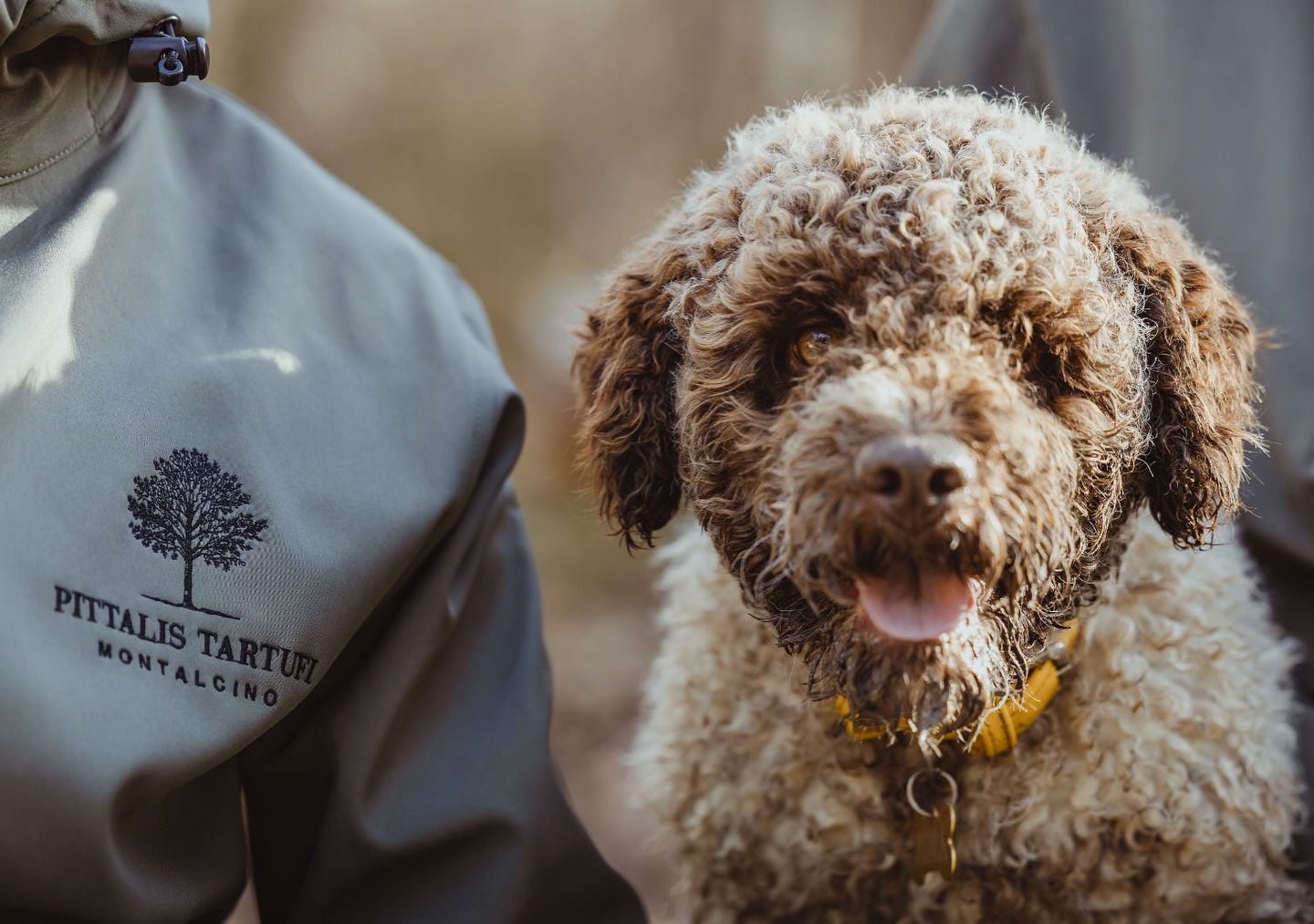
We were seated on the patio of Il Pelo nell’Uovo, an agriristorante just outside of Montalcino, on a warm summer night. Gabriele, the restaurant’s owner, is also the geometra who has overseen the renovation of our home in Montalcino. Gabriele’s partner, Ellen, owns a white truffle reserve, and Mia is her new pup. Mia’s father, Asso (“Ace” in English), is an expert cane da tartufo—a truffle-hunting dog. With time and training, Mia will become one too.
Mia and Asso are Lagotto Romagnolos, a small, curly-coated Italian breed that excels at truffle hunting thanks to natural traits and centuries of selective breeding. Their exceptional sense of smell enables them to detect truffles buried deep underground. Bred to search, Lagotti are patient, persistent, and focused. They’re intelligent, quick learners, able to read subtle scent changes and adjust their search patterns. And importantly, they have natural digging instincts and small, strong paws.
Se tornate in autunno, andiamo a tartufi. “If you return in the fall, we’ll go truffle-hunting,” Gabriele said.
Sabato andiamo a tartufi
It was October, and we’d been back in Montalcino for several days when Stefano received a WhatsApp message. Looking up from his phone, he said, “Sabato andiamo a fare i tartufi con Gabriele e Ellen.” Saturday, Gabriele and Ellen are taking us truffle hunting.
“Do they know that Luca and your mom will be here?” I asked. “Sì,” Stefano replied. We’re all invited.
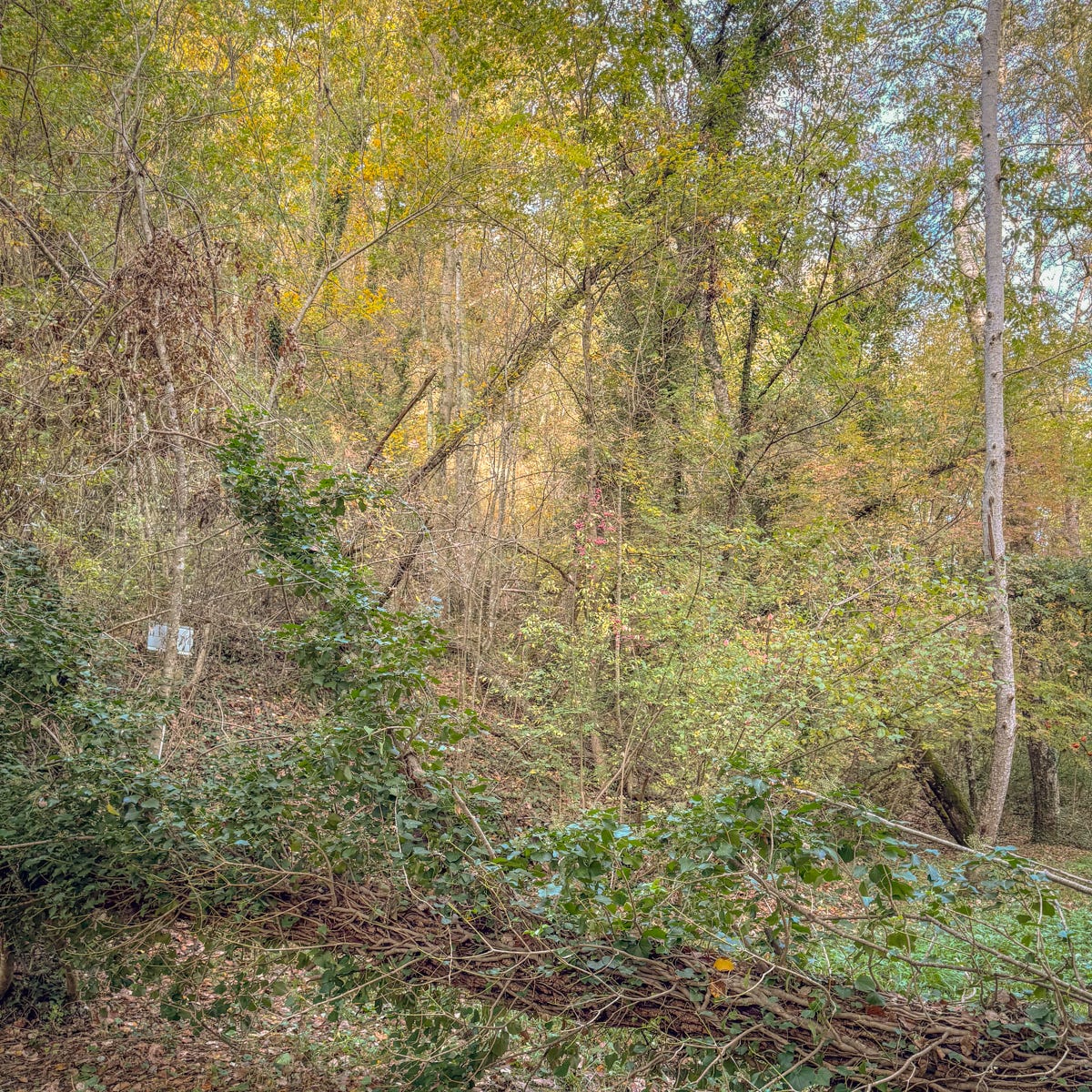
On Saturday morning—equipped with new rubber boots from Ferramenta Montalcinese, the local hardware store—we met Gabriele and Ellen at Il Pelo nell’Uovo and followed them a few minutes down the road to Ellen’s family’s home, where we parked our cars. Stefano’s mom and I piled into a 4x4 Jeep with Ellen and the two dogs, Mia and Asso, and we drove off-road down a hill to the entrance of a wooded valley. Stefano, Luca, and Gabriele followed on foot.
It was a beautiful, sunny day, perfect for a romp in the woods. If we were lucky, we’d find our dinner.


The hunt
We’d barely stepped into the tartufaia when Asso—who had been trotting a few feet ahead of us, nose to the ground—suddenly took off in a mad dash. Ellen and Gabriele sprang into action and sprinted after him. Startled, we ran too.
By the time we caught up, Asso was already digging, his paws moving in rapid succession and flinging dirt behind him. Ellen gently pulled him aside while Gabriele dropped to his hands and knees to inspect the hole he’d started. Brushing away the loose earth with his fingers, he said, “Eccolo!” After a bit more careful work, he unearthed a respectably sized, round truffle. Ellen turned it over in her hand, estimating its weight at just under 100 grams, before passing it around so we could each feel it and inhale that unmistakable scent.
What luck, we thought. Bravo, Asso!
Ellen slipped the truffle into the pocket of her vest—a gesture that struck us as almost comically casual, considering that the round, lumpy underground fungus she’d just pocketed was worth a couple of thousand euros.


For the next few hours, we wandered through the woods looking for more truffles—or, more accurately, watching Asso hunt for them. We mostly walked in straight lines, but Asso covered the ground strategically, zigzagging back and forth with his nose to the earth, searching for the distinctive scent of a truffle growing below. Mia followed her father, sometimes sniffing and digging, but often frolicking.
Every so often, there were false alarms. Sometimes Asso would dig where a truffle had previously been extracted, the earth still holding the smell. Other times he unearthed a tartufo non commestibile, a lesser, non-edible species. The first time this happened, when we looked puzzled at Asso digging and no one running to him, Ellen explained that she can tell when it’s a “bastard” truffle because the dogs dig less energetically—often with just one paw.
By mid-afternoon, we were nearly ready to turn back, grateful that we’d at least found one truffle and weren’t leaving empty-handed, when Asso, sniffing around a patch of weeds, suddenly began to dig with gusto. We sprinted over and watched, full of anticipation and awe, as Asso, Ellen, and Gabriele worked together to locate the underground treasure. This truffle, buried deeper and tangled in roots, took more effort to extract.
Asso, with his precision nose and digging prowness, was allowed to loosen the earth and zero in on the exact location of the truffle. Then, not wanting him to damage the truffle or, worse, eat it, Ellen and Gabriele pulled him aside and used their hands and tools to work it free. After several back-and-forth cycles, they were close.
Asso: master truffle hunter
Mia, curious about the commotion, stuck her nose into the action. Recognizing a perfect training moment, Ellen and Gabriele asked us to hold Asso back while they encouraged Mia to smell and dig for the truffle. At first she was confused, but she caught on quickly. Energized by all the positive attention, she sniffed, dug, rolled in the dirt, then sniffed and dug some more until finally she reached the prized underground fungus—and was rewarded with hugs, treats, and enthusiastic praise.
At only five months old, she’d found her first truffle!
Mia: truffle hunter in training
We walked together out of the woods and back into the clearing, where we piled into the Jeep—tired, dirty, happy, and a bit intoxicated by the aroma of the 180 grams of truffles tucked into the pockets of Ellen’s vest.
That afternoon, cleaned up and back at the agriristorante, we enjoyed our truffles shaved over homemade tagliolini prepared by Chef Flavio, who, as his name suggests, is from Rome.


Resources
Italy’s white truffle season lasts roughly from October to January. White truffles are found in many parts of the country—Piedmont being the best known, along with Umbria, Tuscany, Marche, Abruzzo, Molise, and even as far south as Calabria and Basilicata. During this period, many small towns host truffle festivals, and restaurant menus often feature seasonal truffle dishes.
If you are in Tuscany near Montalcino any time of the year, we recommend stopping by Gabriele’s agriturismo Il Pelo nell’Uovo (The Feather in the Egg), where you can enjoy traditional, seasonal dishes prepared with locally sourced, high-quality ingredients in an idyllic setting with beautiful views.
If you’d like to forage your own truffles and meet Ellen, Asso, and Mia in person, you can arrange a truffle-hunting expedition, followed by a truffle tasting or a full lunch, through Ellen’s family business, Pittalis Tartufi. Even if you don’t have immediate plans to visit the Montalcino area, their beautiful website offers a lovely way to experience it vicariously.
In the US, you can order Italian white truffles online from Urbani Truffles, Alma Gourmet, and Eataly. If you splurge on one, as we did over the Thanksgiving holiday weekend, you’ll also need a truffle slicer, available anywhere truffles are sold.
In Tuscany, truffles are sliced thin and served raw over fresh egg pasta with butter, over eggs cooked sunny-side up, or atop beef tartare.


So jealous
Really, is there a better autumnal activity? Love this.